
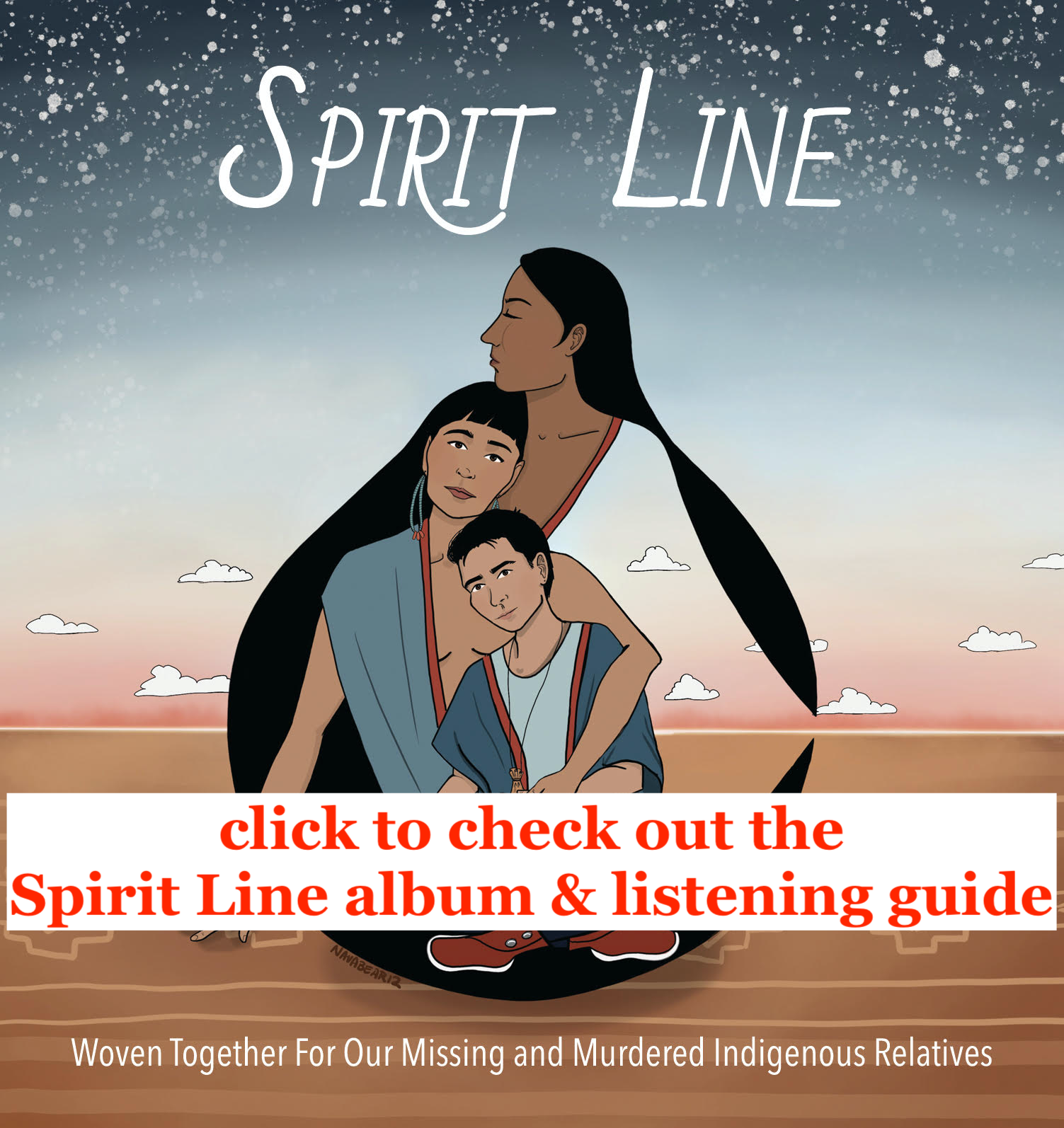
Spirit Line
Woven Together for Our Missing and Murdered Indigenous Relatives
Trigger Warning: Due to explicit content discretion is advised.
Creative Director: Clara Natonabah
Producer: Ishita Sinha
Album Mastered by: Kaushlesh “Garry” Purohit
Co-Funded by: Clara Natonabah & Three Sisters Collective
Album Artwork and Design by: Nicole Neidhardt

Ch’ihónít’i (spirit line): the weaver’s pathway for traveling spirits
Spirit Line was originally released as a CD in August 2019 during 3SC event “In Solidarity” at the Santa Fe Indigenous Center, proceeds were donated to the Sovereign Bodies Institute. In honor of national MMIW Awareness Day, we are now re-releasing it for free streaming and downloading via Soundcloud, in tandem with an Educational Resource and Listening Guide.
It is our collective prayer that our album, Spirit Line: Woven Together For Our Missing and Murdered Indigenous Relatives, will be used as an educational resource for your community, school, or organization. The supplemental listening guide is designed to work with the album to help facilitate deep listening and create an opportunity for healing through guided movement, storytelling, and community engagement. Together we can inspire change and action to address the MMIR epidemic.
In Solidarity!
Clara Natonabah & Three Sisters Collective
O’ga P’ogeh, Santa Fe, New Mexico 2021

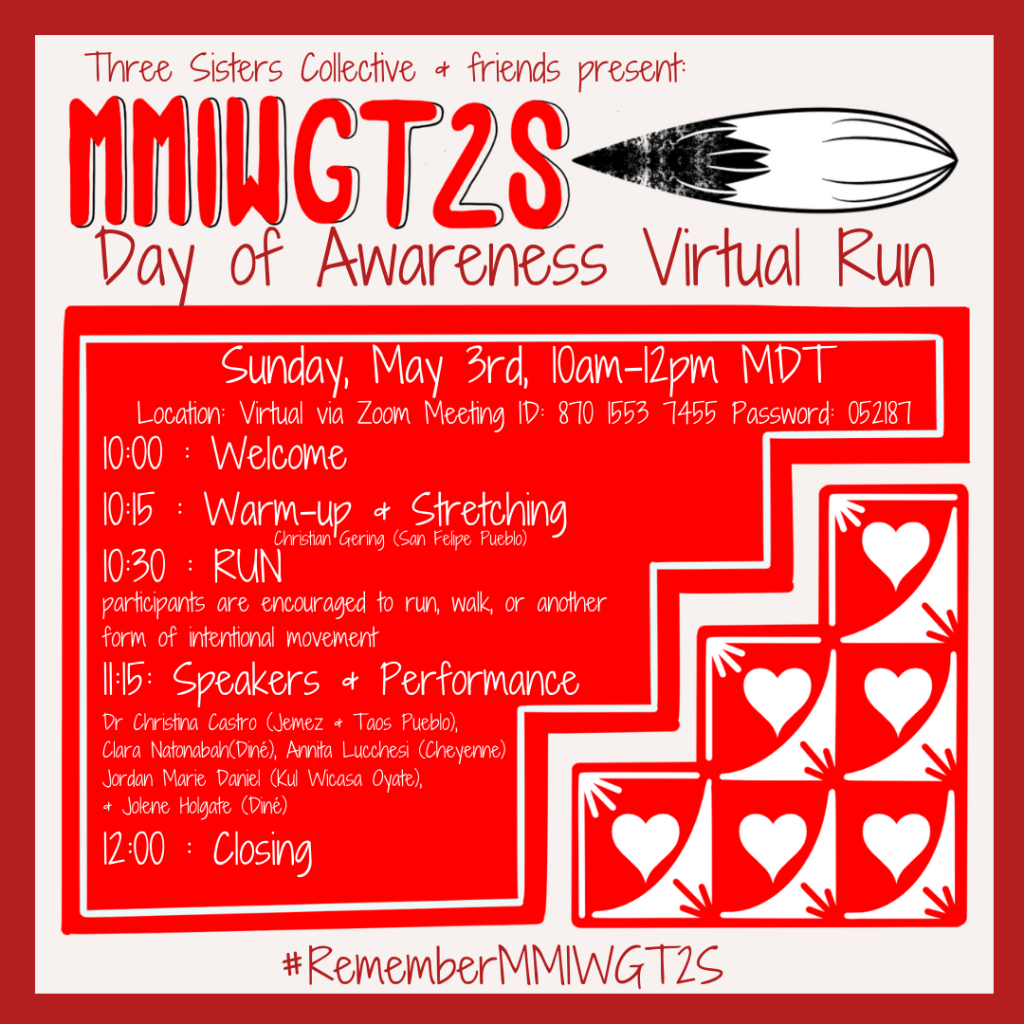
MMIWGT2S+ Day of Awareness
May 3, 2020
If you missed our event, please watch the recording of the presentations by people doing work related to MMIWGT2S:
Not Another Statistic
May 3, 2020
Santa Fe Indian School Performing Arts 2020
missing & murdered Diné relatives
MISSING AND MURDERED INDIGENOUS WOMEN, GIRLS, TRANS, & TWO SPIRITS
Cities with highest number of MMIWG cases in 2017*:
States with the highest number of MMIWG cases in 2017*:
Seattle, WA (45)
Albuquerque, NM (37)
Anchorage, AK (31)
Tucson, AZ (31)
Billings, MT (29)
Gallup, NM (25)
New Mexico (78)
Washington (71)
Arizona (54)
Alaska (52)
Montana (41)
California (40)
*as reported by the Urban Indian Health Institute
How to be a Better Ally
- Transfer the benefits of your privilege to those who have less
- Acknowledge that the conversation is not about you
- Educate yourself on the history of Indigenous Peoples
- Seek out Indigenous created/supported resources
- Remember that Indigenous Peoples are the experts of their own realities and histories
- Learn about and acknowledge the ancestral lands you’re on (check out native-land.ca)

